Translation Is Interpretation: Why Narrative Precision Matters in English–Arabic Communication
Discover why English–Arabic translation requires more than word substitution. Narrative Axis explains how cultural nuance, narrative integrity, and translation ethics shape high-stakes communication.

Interview multiple candidates
Lorem ipsum dolor sit amet, consectetur adipiscing elit proin mi pellentesque lorem turpis feugiat non sed sed sed aliquam lectus sodales gravida turpis maassa odio faucibus accumsan turpis nulla tellus purus ut cursus lorem in pellentesque risus turpis eget quam eu nunc sed diam.
Search for the right experience
Lorem ipsum dolor sit amet, consectetur adipiscing elit proin mi pellentesque lorem turpis feugiat non sed sed sed aliquam lectus sodales gravida turpis maassa odio.
- Lorem ipsum dolor sit amet, consectetur adipiscing elit.
- Porttitor nibh est vulputate vitae sem vitae.
- Netus vestibulum dignissim scelerisque vitae.
- Amet tellus nisl risus lorem vulputate velit eget.

Ask for past work examples & results
Lorem ipsum dolor sit amet, consectetur adipiscing elit consectetur in proin mattis enim posuere maecenas non magna mauris, feugiat montes, porttitor eget nulla id.
- Lorem ipsum dolor sit amet, consectetur adipiscing elit.
- Netus vestibulum dignissim scelerisque vitae.
- Porttitor nibh est vulputate vitae sem vitae.
- Amet tellus nisl risus lorem vulputate velit eget.
Vet candidates & ask for past references before hiring
Lorem ipsum dolor sit amet, consectetur adipiscing elit ut suspendisse convallis enim tincidunt nunc condimentum facilisi accumsan tempor donec dolor malesuada vestibulum in sed sed morbi accumsan tristique turpis vivamus non velit euismod.
“Lorem ipsum dolor sit amet, consectetur adipiscing elit nunc gravida purus urna, ipsum eu morbi in enim”
Once you hire them, give them access for all tools & resources for success
Lorem ipsum dolor sit amet, consectetur adipiscing elit ut suspendisse convallis enim tincidunt nunc condimentum facilisi accumsan tempor donec dolor malesuada vestibulum in sed sed morbi accumsan tristique turpis vivamus non velit euismod.
English–Arabic translation is often described as the movement of words from one language into another. That description is convenient, but it is also misleading. Words do not travel alone. They carry tone, context, assumptions, cultural memory, institutional authority, and narrative force. When a text moves between English and Arabic, it does not simply change linguistic form. It enters another system of meaning.
This is why translation should not be treated as substitution. It is interpretation.
For academic institutions, publishers, cultural organizations, ministries, researchers, and writers, this distinction matters. A technically accurate translation can still fail if it distorts tone, flattens cultural meaning, misreads audience expectations, or weakens the structure of the original argument. In high-stakes communication, precision is not only grammatical. It is narrative, cultural, and ethical.
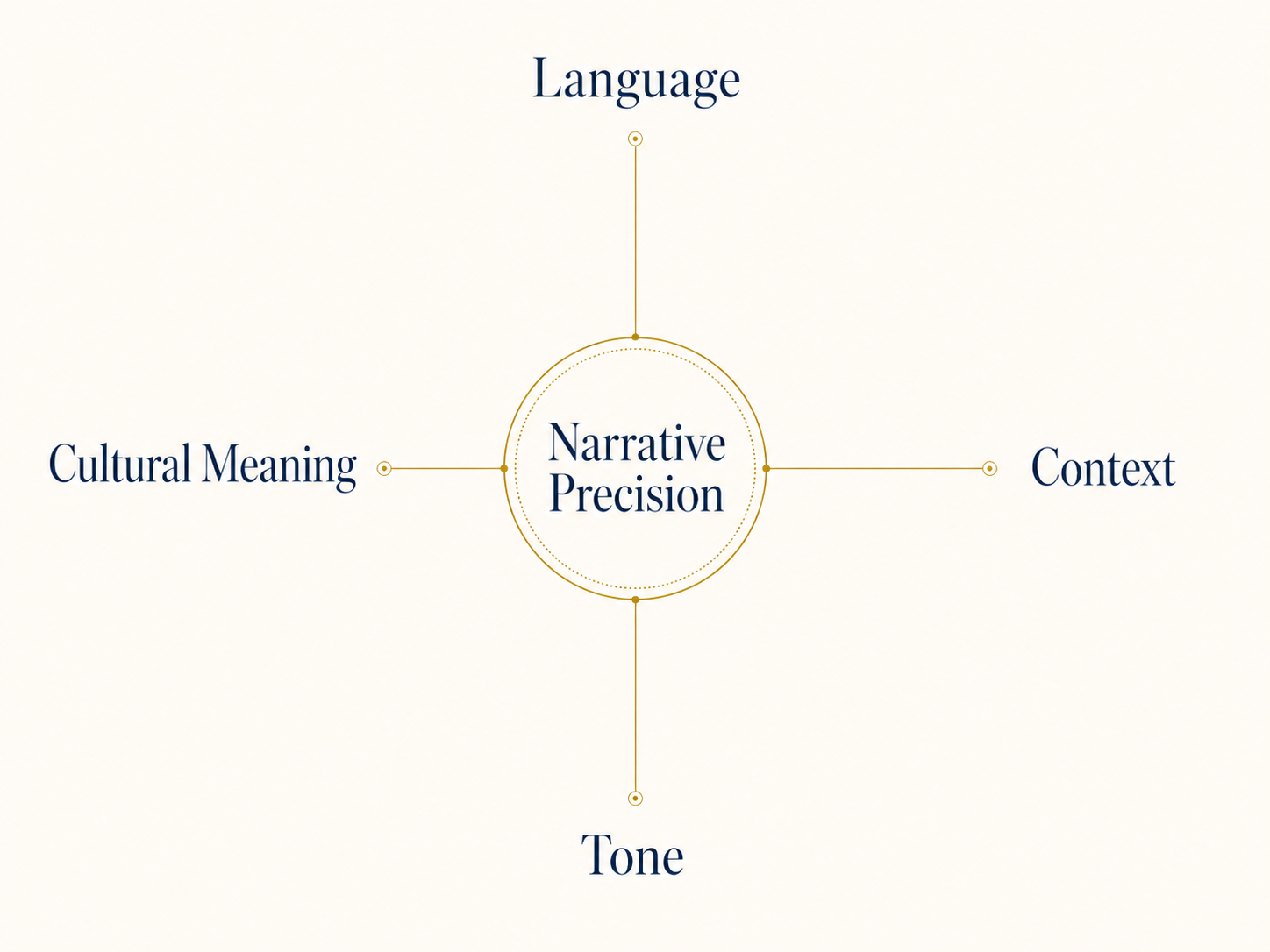
At Narrative Axis, we use the term narrative precision to describe this fuller standard of translation: the disciplined preservation of meaning, structure, tone, and cultural integrity across languages.
Translation Is Not Substitution
Substitution assumes that every word has a direct counterpart. It imagines translation as a search for equivalent terms: this word becomes that word; this sentence becomes that sentence; this paragraph becomes its bilingual mirror.
But English and Arabic do not organize meaning in identical ways. They differ in rhythm, idiom, rhetorical expectation, formality, metaphor, abstraction, and modes of emphasis. A phrase that sounds clear and persuasive in English may sound cold, vague, excessive, or culturally misaligned in Arabic. A sentence that works elegantly in Arabic may feel too ornate, indirect, or structurally dense in English if transferred too literally.
This is not a problem of vocabulary. It is a problem of interpretation.
The translator must ask not only, “What does this sentence say?” but also:
• What is this sentence doing?
• Who is it addressing?
• What tone does it establish?
• What assumptions does it carry?
• What cultural or institutional authority does it invoke?
• How does it contribute to the larger narrative of the document?
A translation that answers only the first question may be accurate at the surface level but unreliable at the level of meaning.
What Narrative Precision Means
Narrative precision is the practice of protecting a text’s meaning as it moves across linguistic and cultural boundaries. It requires attention to the relationship between sentence-level accuracy and larger patterns of communication.
A text is never only a collection of sentences. It has a structure. It has implied values. It positions its speaker and audience. It frames a subject in a particular way. It invites trust, authority, empathy, urgency, or reflection. These effects are narrative effects, even when the text is not literary.
A government report tells a story about institutional priorities. A university brochure tells a story about intellectual identity. A museum label tells a story about memory and cultural value. A journal article tells a story about evidence, argument, and scholarly contribution. A manuscript tells a story not only through plot, but through perspective, voice, and representation.
When translation ignores these narrative dimensions, the result may be fluent but incomplete.
Narrative precision asks the translator or consultant to preserve four interrelated elements:
1 Linguistic accuracy — the correct rendering of meaning at the level of words and sentences.
2 Structural coherence — the preservation of argument, sequence, emphasis, and textual logic.
3 Cultural intelligence — awareness of references, values, sensitivities, expectations, and audience positioning.
4 Ethical representation — responsible handling of identity, history, place, voice, and cultural difference.
Together, these elements move translation beyond technical correctness toward interpretive reliability.
Cultural Nuance Is a Structural Issue
Cultural nuance is often treated as decoration: a matter of idioms, metaphors, or local expressions. In reality, it is structural. It shapes how a text is received, trusted, and understood.
Consider the word “community.” In English-language institutional writing, it may signal inclusion, civic participation, or public engagement. Depending on context, its Arabic rendering may require careful adjustment to avoid sounding vague, bureaucratic, overly literal, or socially imprecise. The issue is not whether “community” can be translated. It can. The issue is what kind of social relationship the word is meant to establish.
The same applies to terms such as “empowerment,” “heritage,” “diversity,” “authenticity,” “innovation,” “representation,” and “public engagement.” These terms are common in academic, cultural, and institutional writing, but they are not culturally neutral. They carry histories of use. They belong to particular policy, academic, corporate, or cultural discourses. Their translation requires judgment.
In English–Arabic communication, nuance is especially important because audiences may differ not only linguistically, but also rhetorically. What counts as persuasive, respectful, authoritative, elegant, or clear can shift across contexts. A strong translation therefore does not merely ask whether the target text is correct. It asks whether the target text performs the same communicative work.

Translation Ethics: Why Accuracy Is Not Enough
Accuracy is essential, but it is not sufficient.
A translation can be accurate and still ethically weak. It may reproduce stereotypes, soften politically or culturally significant distinctions, erase local specificity, or impose an external framework on a culturally situated text. It may make a voice sound more Western, more bureaucratic, more academic, or more simplified than it is. It may also overcorrect, making a text sound artificially “cultural” in ways that distort its actual register.
Translation ethics begins with the recognition that language carries power. Translators and editors make choices that affect how people, cultures, institutions, and histories are represented. These choices are not neutral.
For publishers, this matters in the representation of Arab and Arab American characters, settings, and histories. For universities, it matters in research dissemination, graduate writing, and scholarly communication. For cultural institutions, it matters in exhibition texts, public programming, and bilingual interpretation. For ministries and organizations, it matters in public-facing documents where credibility depends on clarity and cultural trust.
Ethical translation is therefore not only about avoiding errors. It is about preserving complexity without creating confusion, and communicating clearly without flattening difference.
Why Academic Translation Requires More Than Language Fluency
Academic translation has its own demands. It requires disciplinary awareness, argument sensitivity, and familiarity with scholarly conventions. A translator working on an academic article, book chapter, dissertation, or research report must understand not only the language but also the intellectual architecture of the text.
In academic writing, meaning often depends on the relationship between claim, evidence, method, theory, and contribution. If a translator misunderstands that architecture, the translation may weaken the argument even if individual sentences are grammatically sound.
This is especially important in the humanities and social sciences, where concepts are often contested, historically situated, and theoretically dense. Terms such as “subjectivity,” “representation,” “modernity,” “diaspora,” “narrative authority,” “cultural translation,” and “world literature” cannot be handled mechanically. They belong to scholarly conversations. Their translation requires conceptual accuracy.
For this reason, high-level academic translation benefits from an editorial process that includes:
• Terminology mapping
• Citation and style awareness
• Register calibration
• Argument tracking
• Conceptual consistency
• Review of disciplinary vocabulary
• Sensitivity to publication standards
The goal is not only to produce readable translation. The goal is to produce intellectually reliable translation.
Institutional Communication and the Risk of Misalignment
Institutions often communicate across languages under pressure: reports, brochures, speeches, policy documents, exhibition materials, website copy, media statements, and stakeholder briefings. These texts must be clear, polished, and culturally credible.
The risk is that institutional translation can become either too literal or too generic. Literal translation may sound rigid, unnatural, or unclear. Generic translation may remove specificity and weaken the institution’s voice. In both cases, the translated document may fail to represent the institution accurately.
Narrative precision helps institutions avoid this problem by asking strategic questions before translation begins:
• What is the document’s purpose?
• Who is the primary audience?
• Is the desired tone scholarly, diplomatic, executive, public-facing, or cultural?
• What terms require consistency across the organization?
• Are there cultural references that need explanation, adaptation, or preservation?
• What reputational risks might emerge from tone, omission, or mistranslation?
These questions transform translation from a reactive service into a strategic communication process.
Narrative Consulting: When the Problem Is Larger Than Translation
Sometimes the issue is not only how a text should be translated. The issue is how the narrative itself is structured.
A manuscript may contain representational problems that become more visible when prepared for another audience. A cultural report may contain unclear framing. A museum text may need stronger interpretive coherence. A film script may rely on familiar assumptions about Arab identity, migration, gender, religion, or place. An institutional message may be linguistically correct but narratively unconvincing.
In these cases, translation alone is not enough. The text needs narrative consulting.
Narrative consulting examines how a text constructs meaning. It asks how perspective, sequence, voice, representation, and cultural framing shape audience interpretation. It is especially useful for publishers, writers, media producers, and institutions working with culturally sensitive material.
This process may include:
• Manuscript evaluation
• Cultural representation review
• Narrative reliability assessment
• Structural analysis
• Tone and audience review
• Recommendations for revision
• Cross-cultural risk analysis
The goal is not to make every narrative safe, simple, or neutral. The goal is to make it coherent, responsible, and aware of the cultural work it performs.
A Practical Framework for High-Stakes English–Arabic Translation
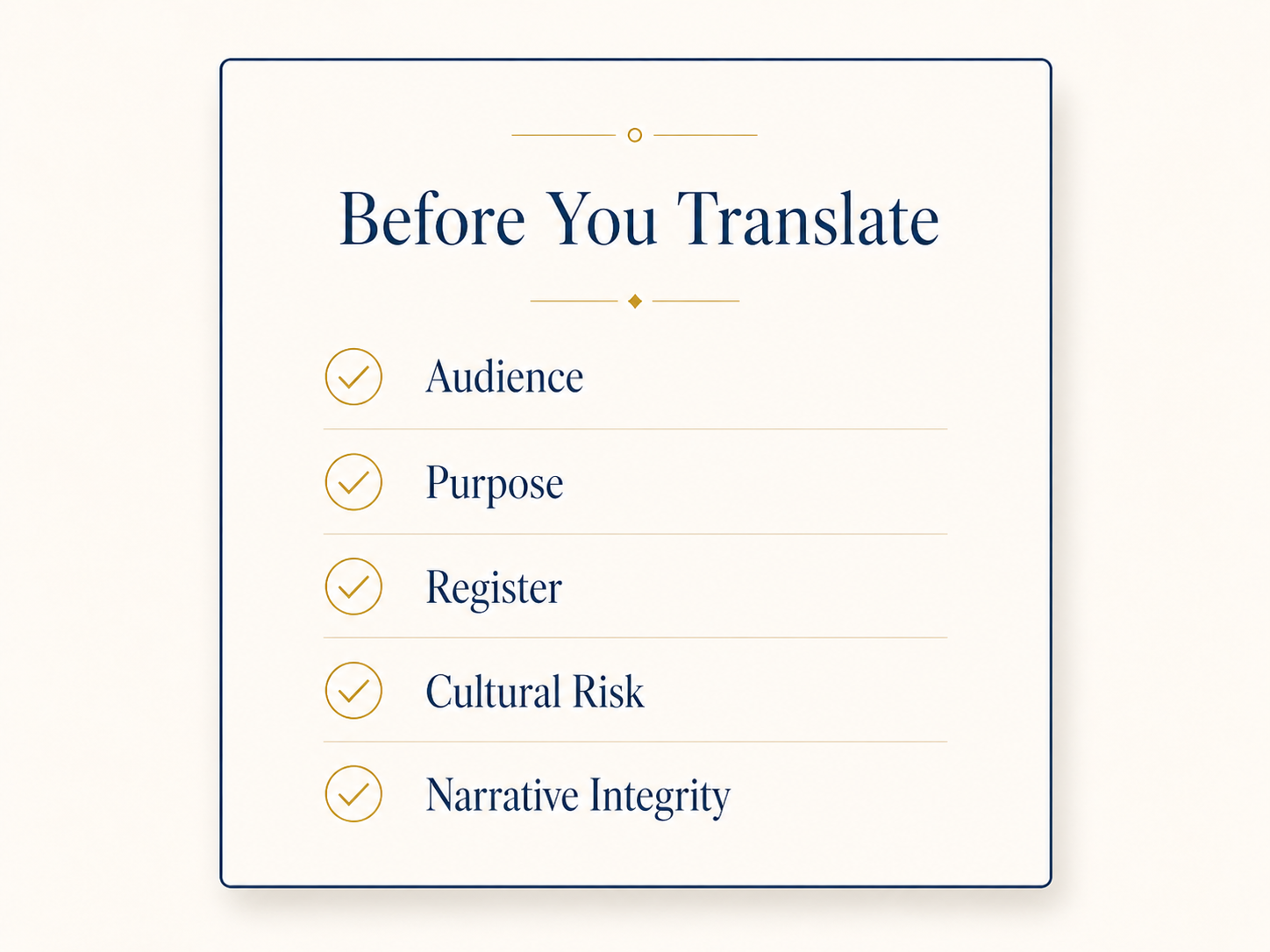
Before beginning a translation project, organizations and writers should clarify five elements.
1. Audience
Who will read the translated text? A scholarly audience, a public audience, a government stakeholder, a publisher, a grant committee, or an international reader will each bring different expectations.
2. Purpose
Is the text meant to inform, persuade, represent, explain, promote, analyze, or invite action? Purpose determines tone and structure.
3. Register
Should the translation be formal, literary, academic, accessible, institutional, diplomatic, or public-facing? Register is one of the most common sources of misalignment in English–Arabic translation.
4. Cultural Risk
Does the text involve identity, religion, heritage, gender, politics, history, migration, representation, or regional specificity? If so, it requires heightened cultural review.
5. Narrative Integrity
Does the translation preserve the original text’s structure, emphasis, voice, and ethical orientation? If not, the translation may be linguistically correct but narratively unreliable.
Why Narrative Axis Uses an Interpretive Approach
Narrative Axis was founded on the belief that language work should be intellectually rigorous, culturally informed, and ethically attentive. Our work sits at the intersection of translation, academic editing, narrative consulting, and cross-cultural communication.
We support clients whose texts require more than standard proofreading or basic translation. These include scholars preparing work for publication, publishers evaluating culturally complex manuscripts, institutions producing bilingual communication, and writers seeking narrative and representational clarity.
Our approach is grounded in four principles:
• Linguistic precision — careful attention to meaning, terminology, grammar, and style.
• Narrative coherence — preservation of structure, argument, voice, and interpretive movement.
• Cultural intelligence — awareness of Arab, Western, and transnational contexts.
• Ethical representation — responsible treatment of identity, culture, history, and perspective.
These principles allow us to deliver translation and consulting work that is not only polished but trustworthy.
Conclusion: Meaning Travels Carefully
Translation is one of the most important forms of cross-cultural communication. It determines how texts move, how institutions are understood, how cultures are represented, and how ideas enter new intellectual and public contexts.
English–Arabic translation, in particular, requires more than fluency. It requires judgment, cultural knowledge, rhetorical sensitivity, and narrative intelligence. It requires the ability to see not only what the words say, but what the text is trying to do.
That is why translation is interpretation.
And interpretation, when done well, protects meaning.
Call to Action
If your project requires English–Arabic translation, academic editing, narrative consulting, or cross-cultural communication advisory, Narrative Axis provides premium, intellectually grounded support for high-stakes texts.
Request a consultation to discuss your document, manuscript, institutional message, or cultural project.
FAQ
What makes English–Arabic translation difficult?
English–Arabic translation is difficult because the two languages differ not only in vocabulary but also in syntax, register, rhetorical style, cultural assumptions, and audience expectations. High-quality translation must preserve meaning, tone, structure, and cultural context.
What is narrative precision?
Narrative precision is the disciplined preservation of meaning, structure, tone, and cultural integrity across languages and contexts. It ensures that a translated or revised text remains coherent, accurate, and ethically reliable.
Do academic articles need specialized translation?
Yes. Academic articles require translators who understand disciplinary terminology, argument structure, citation conventions, and publication expectations. This is especially important in the humanities and social sciences, where concepts are often theoretically complex.
What is cultural representation review?
Cultural representation review evaluates how a text portrays identities, communities, histories, and cultural contexts. It helps writers, publishers, and institutions avoid distortion, simplification, or unintended misrepresentation.
When should an institution request cross-cultural communication advisory?
An institution should request cross-cultural communication advisory when preparing bilingual reports, public messaging, campaigns, speeches, exhibition text, or high-stakes documents for audiences across Arab and Western contexts.

Related posts



Intellectually Grounded Communication Support
Whether you need translation, editorial refinement, narrative analysis, or communication strategy, Narrative Axis delivers tailored support aligned with the complexity of your work.